Die mit 9MB/s auf der extrememory-Website angegebene Schreibgeschwindigkeit des SNIPPY unterscheidet sich doch recht deutlich von den im Datenblatt angegebenen 3MB/s.
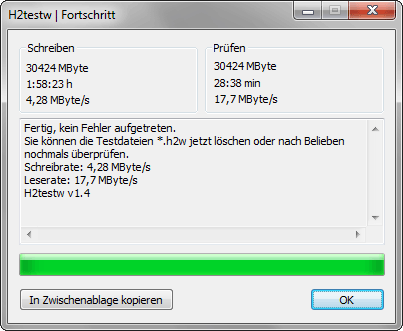
Ein Testlauf mit H2testw wurde mit einer Schreibrate von 4,28MB/s durchgeführt.

Die mit 9MB/s auf der extrememory-Website angegebene Schreibgeschwindigkeit des SNIPPY unterscheidet sich doch recht deutlich von den im Datenblatt angegebenen 3MB/s.
Ein Testlauf mit H2testw wurde mit einer Schreibrate von 4,28MB/s durchgeführt.
Statt eine Joomla!-Installation von der Version 1.5 auf die Version 2.5 zu migrieren kann es für kleine Websites auch eine Überlegung wert sein, eine Migration auf WordPress durchzuführen.
Wordpress ist zwar eigentlich als Blog-System gedacht, lässt sich aber ohne große Umstände als CMS “missbrauchen”.
Wie im Joomla! Developer Network zu lesen hat Joomla! 1.5 Ende April 2012 sein End-of-Life erreicht, Sicherheitsupdates werden voraussichtlich noch bis zum Erscheinen der Version 3.0 im September 2012 angeboten - höchste Zeit also, über einen Wechsel auf eine neuere Joomla!-Version nachzudenken.
Joomla! 1.5.26
End of Support:
April 2012.
Note:
Major security fixes will be done until release of 3.0 in September 2012.
Wie der offizielle “Upgrading and Migrating Joomla"-Leitfaden beschreibt, ist es mit einem einfachen Update nicht getan, der Wechsel erfordert eine vollständige Migration der vorhandenen Daten. Als Zielversion bietet sich aktuell nur die Version 2.5 an, denn die Versionen 1.6 und 1.7 haben im August 2011 bzw. Februar 2012 ebenfalls bereits ihr End-of-Life erreicht.
Als grober Wegweiser durch die Migration steht das Dokument “Migrating from Joomla 1.5 to Joomla 2.5” zur Verfügung, welches einmal die Migration mittels der Komponente jUpgrade als auch die notwendigen Schritte für eine Migration von Hand beschreibt.
Vor allem letzteres sollte nach Möglichkeit vermieden werden, denn
Convert the table schemas in the .sql file you exported in step 2 (containing your Joomla 1.5 tables) such that they are compatible with the version of Joomla! you are upgrading to. This is a very tedious process - you’ll have to check the database schemas for changes between the version of Joomla you’re upgrading from and the 2.5 version you’re upgrading to, and modify the SQL file accordingly.
das manuelle Ändern der Tabellenstrukturen dürfte sich langwierig und frustrierend gestalten.
Für einen ersten Migrationsversuch, wurde eine sehr kleine Website ausgewählt, die mit einem Benutzer, keinen selbstdefinierten Bereichen und Kategorien, neun Beiträgen sowie ausschließlicher Verwendung von Core-Komponenten einer Minimal-Installation von Joomla! sehr nahe kommt.
Die Funktionalität von stripClip, einem kleinen Utility zum Entfernen von Textformatierungen aus der Zwischenablage lässt sich - sofern sowieso ein Perl-Interpreter installiert ist - auch mit wenigen Zeilen Perl-Code realisieren:
use warnings;
use strict;
use Win32::Clipboard;

my($text);

my $clip = Win32::Clipboard();

do {

	$clip->WaitForChange();

	if ($clip->IsText()) {
		$text = $clip->GetText();
		$clip->Set($text);
	}

} while ($text ne ':q');
Startet man das Skript mit ‘wperl.exe’ statt mit ‘perl.exe’, stört kein Fentser und das Skript lässt sich ohne Taskmanager durch Kopieren von ‘:q’ beenden.
 When copying text from one rich text editor to another, the original format will be preserved by the Windows clipboard. While this behaviour might be wanted in some scenarios, sometimes - when copying from Microsoft Word to a CMS backend for example - copying just the contents without the format would be the preferred way.
A quick & dirty solution is to copy the text first to the Windows Notepad, and then from Notepad to the target application - a way that might be suitable a few copies but also a way that get’s frustrating when having to copy a larger quantity of text snippets.
This is where stripClip comes in: a lightweight (32kb) application that - when active - strips the format from text the moment the text is copied to the clipboard.